


Infrared heaters warm people and objects directly, not the air in between
Most space heaters work by warming the air in a room and waiting for that warm air to reach you. Infrared heaters skip the middleman: they emit radiant heat that's absorbed directly by people, furniture, and floors, the same way sunlight feels warm on your skin even on a cold day. The practical upshot is that you feel warm almost immediately rather than waiting ten minutes for the room to catch up, and you're not losing heat every time someone opens a door.
That also makes them well suited to zone heating — warming the one room you're actually sitting in rather than the whole house. Below are six infrared heaters covering very different situations, from a wall-mounted bathroom unit to a fireplace-style stove, plus what to look for before you buy.
Quick verdict: for most living rooms, the EdenPURE CopperSMART is the strongest all-round pick, with no exposed heating elements and a genuinely long-life element. If floor space is tight, the wall-mounted Heat Storm Phoenix is the smartest use of a small room. And for a workshop or garage, the Dr. Infrared DR-988 is in a different class entirely — though note it needs a 240V circuit.
Quick Comparison
| Heater | Power | Style | Best For |
|---|---|---|---|
| EdenPURE CopperSMART | 1000–1500W | Portable cabinet | Best overall for living spaces |
| Heat Storm Phoenix WiFi | 750–1500W | Wall-mounted | Small rooms, bathrooms, offices |
| Duraflame 3D Stove | 1500W | Fireplace stove | Heat plus flame-effect ambiance |
| LifeSmart Quartz | 1500W | Wood cabinet | Furniture-style looks |
| iLIVING ILG918 | 1500W | Portable cabinet | Quiet operation |
| Dr. Infrared DR-988 | 5600W (240V) | Industrial | Garages and workshops |
Our Top Picks
Best Overall1. EdenPURE CopperSMART Portable Infrared Heater
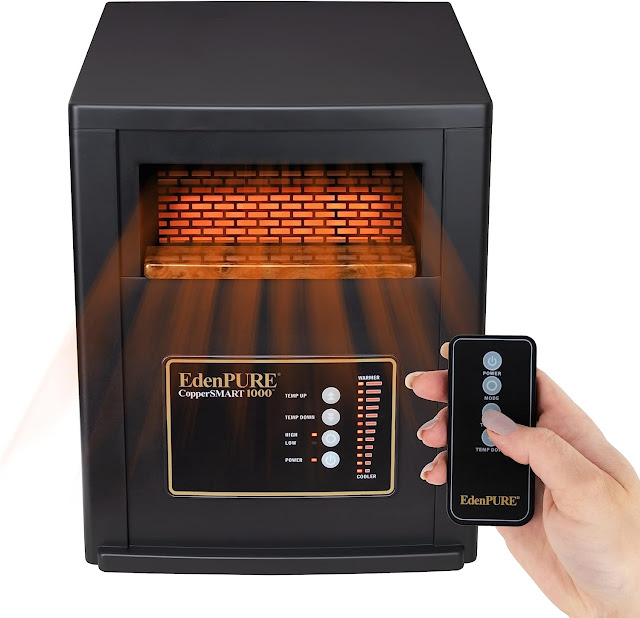
EdenPURE built the CopperSMART around copper PTC heating elements rather than the quartz bulbs most infrared heaters use, and the practical difference is real: there's nothing to burn out and need replacing. The company rates the element for around 80,000 hours of use, which for seasonal heating is effectively the life of the appliance.
It's also the safest-feeling unit here. There are no exposed heating elements, dual high-limit sensors cut power if internal temperatures climb too far, and an anti-tilt sensor shuts it off if it's knocked over — worth having if you have pets or kids moving around the room. A 24-hour programmable timer with automatic on and off means you can have it warm the room before you get up rather than running all night.
Practical touches round it out: 24 heat settings, separate high and low modes for larger and smaller rooms, a digital display, a remote, a washable lifetime filter, and wheels so you can move it between rooms without lifting it. The main complaint in owner feedback is fan noise — it's not loud, but it's audible, and light sleepers notice it in a bedroom.
Specifications
- Power: 1000–1500W
- Element: Copper PTC, rated approx. 80,000 hours
- Safety: Dual high-limit sensors, anti-tilt sensor, ETL listed
- Extras: 24 heat settings, 24-hour programmable timer, remote, washable lifetime filter, wheels
Pros
- No bulbs or elements to burn out and replace
- No exposed heating elements, with genuinely thorough safety sensors
- 24-hour programmable timer with auto on and off
- Wheels and a remote make day-to-day use easy
Cons
- Fan noise is noticeable in a quiet bedroom
- Cabinet gets warm during extended use
- Priced above basic quartz heaters
2. Heat Storm HS-1500-PHX-WIFI Phoenix Infrared Heater

The Phoenix solves a specific problem well: heating a small room where there's no floor space to give up. It mounts on the wall, plugs into a normal household outlet, and disappears into the room in a way a freestanding cabinet heater never does. Bathrooms, home offices, and small bedrooms are its natural home.
Built-in Wi-Fi is the headline feature and it's more useful than it sounds. Beyond turning the heater on from your phone before you get home, the app lets you set custom heating schedules — so a bathroom can be warm at 6:30am on weekdays without running overnight. Setup connects over one-touch Bluetooth rather than the fiddly router pairing older smart heaters used.
The safe-to-touch grill is the detail parents and pet owners should note: unlike most heaters, the front grill itself doesn't get dangerously hot. A child lock prevents anyone changing the settings, and screen brightness is adjustable so the display doesn't glow all night. It runs at 750W or 1500W, and Heat Storm specifically notes 1500W won't trip a standard breaker.
The obvious limitation is that it's a small-room heater. It won't heat an open-plan living area, and wall mounting means committing to a location and doing a small amount of installation work.
Specifications
- Power: 750W / 1500W, standard household outlet
- Mounting: Wall mount (attachable feet available on some versions)
- Smart features: Wi-Fi app control, custom schedules, one-touch Bluetooth setup
- Safety: Safe-to-touch grill, child lock, automatic shut-off
Pros
- Uses zero floor space
- Genuinely useful scheduling through the free app
- Safe-to-touch grill and child lock
- Dimmable display won't disturb sleep
Cons
- Only suited to small and medium rooms
- Smart features need a working Wi-Fi connection
- Wall mounting requires installation and commits you to one spot
3. Duraflame 3D Infrared Electric Fireplace Stove

If you want the look of a wood stove without the chimney, ash, or fire risk, this is the one. Duraflame's 3D flame effect layers the flames at different depths rather than projecting them onto a flat panel, which is what makes it read as a real fire from across the room rather than an obvious screen. Five brightness settings let you tune it from a subtle glow to something closer to a proper blaze.
Crucially, the flame effect runs independently of the heat, so you can have the ambiance in spring and autumn without warming the room. With the infrared quartz heat on, Duraflame rates it for spaces up to 1,000 square feet, which puts it firmly in living-room territory rather than supplemental-corner-heater territory.
The infrared element also doesn't strip humidity from the air the way forced-air heating can, so you get warmth without the dry-eye, dry-skin feeling that makes some rooms uncomfortable in winter. Overheat protection and a cool-to-touch exterior cover the safety basics.
It is a piece of furniture, though — one of the largest units here, and it needs a permanent spot. The fan is audible, and the flame effect, however good, is still a matter of taste.
Specifications
- Power: 1500W
- Coverage: Up to 1,000 sq ft
- Extras: 3D flame effect with 5 brightness settings, flame operates independently of heat, remote control
- Safety: Overheat protection, cool-to-touch exterior
Pros
- 3D flame effect is genuinely convincing, not a flat projection
- Flame runs without heat for year-round use
- Heats a full living room, not just a corner
- Infrared heat doesn't dry out the room
Cons
- Large footprint that needs a permanent home
- Fan noise is noticeable to some owners
- Stove styling won't suit every room
4. LifeSmart Large Room Infrared Quartz Heater

LifeSmart's pitch is that a space heater shouldn't look like a space heater. The oak-finished, furniture-grade wood cabinet is designed to sit in a living room without announcing itself, and the horizontal, space-saving profile takes up less visual weight than a tall tower unit.
Underneath the styling it's a capable quartz heater. Three infrared tube elements deliver even heat, and three heat settings include an ECO mode that holds the room at a steady 68°F rather than cycling between too warm and too cool. The 12-hour start and stop timer is genuinely useful for energy savings — set it to warm the living room before you come downstairs and switch off after bedtime.
The infrared elements are noncombustible, and the exterior cabinet stays cool to the touch, which makes it a reasonable choice around children and pets. A quiet scroll fan circulates the heat, overheat and tip-over protection are both included, and the filter is washable rather than disposable.
It's heavier than most portable heaters, so moving it between rooms is a two-handed job, and owner feedback consistently mentions the remote's limited range.
Specifications
- Power: 1500W
- Elements: 3 infrared quartz tubes
- Extras: 3 heat settings with 68°F ECO mode, 12-hour start/stop timer, washable filter, remote
- Safety: Cool-touch cabinet, overheat and tip-over protection
Pros
- Genuinely attractive furniture-grade wood cabinet
- ECO mode holds a steady 68°F instead of cycling
- 12-hour start and stop timer
- Cool-touch exterior is safe around kids and pets
Cons
- Heavy and awkward to move between rooms
- Remote control has a short effective range
- Better suited to medium rooms than genuinely large open spaces
5. iLIVING ILG918 Infrared Portable Space Heater

If fan noise is what's put you off space heaters before, the ILG918 is the one to look at. iLIVING rates its high-pressure blower at 39 decibels — quiet enough to run in a bedroom or home office without competing with a conversation or a video call. That's the quietest published figure of any heater on this list.
It uses a dual heating system, combining PTC and quartz infrared elements, which lets it bring a room up to temperature faster than a single-element design while still delivering the direct radiant warmth infrared is good at. An electronic thermostat covers 50 to 86°F, and Auto Energy Saving Mode cycles between high and low to hold your set temperature rather than running flat out.
Safety is well covered: UL certified for both the US and Canada, no exposed heating elements, tip-over protection, and auto shut-off on overheat. There's also a 12-hour automatic shut-off timer. Like several units here it retains room humidity rather than drying the air out.
Owner complaints centre on the digital display being hard to read from across a room, and the cabinet running warm during long sessions.
Specifications
- Power: 1500W
- Heating: Dual PTC and quartz infrared system
- Noise: Rated 39 dB
- Thermostat: Electronic, 50–86°F, with Auto Energy Saving Mode
- Safety: UL certified (US and Canada), tip-over protection, 12-hour auto shut-off
Pros
- Quietest heater here at a rated 39 dB
- Dual heating system warms a room quickly
- Auto Energy Saving Mode avoids running at full power constantly
- UL certified with no exposed elements
Cons
- Digital display is difficult to read at a distance
- Exterior gets warm during extended use
- May struggle with very large open-plan spaces
6. Dr. Infrared Heater DR-988 Industrial Garage Heater

The DR-988 is the outlier here, and it's important to be clear about why. This is a 5,600W, 240V industrial heater built for garages, workshops, warehouses, and construction sites. It will not run on a standard household outlet — it needs a 240V circuit, the same type an electric range or clothes dryer uses. If you're heating a living room, one of the five heaters above is what you want.
For a workshop, though, it's genuinely excellent. The output is in a completely different league from a 1500W plug-in heater, and it's designed for spaces where the door opens frequently and a conventional heater would never keep up. The thermostat covers a wide 37–113°F range, so you can hold a garage just above freezing to protect tools and paint, or bring it up to comfortable working temperature.
Build quality reflects the intended environment. Finger-proof intake and discharge grills protect against accidental contact, a high-temperature limit switch guards against overheating, and it can be used portably on the floor or mounted to a wall or ceiling to keep it clear of a work area. A built-in handle makes moving it around straightforward.
Expect noise — this is industrial equipment, not a bedroom appliance — and expect the housing to get hot during sustained use.
Specifications
- Power: 5,600W, 240V circuit required
- Thermostat range: 37–113°F
- Mounting: Portable, wall, or ceiling
- Safety: Finger-proof intake and discharge grills, high-temperature limit switch
Pros
- Far more output than any standard plug-in heater
- Wide thermostat range suits both freeze protection and working comfort
- Portable, wall, or ceiling mounting options
- Built for demanding workshop environments
Cons
- Requires a 240V circuit — not a plug-and-play household heater
- Loud compared to residential units
- Exterior gets hot during prolonged operation
Why Choose Infrared Over a Conventional Heater
You Feel It Immediately
Radiant heat warms you directly rather than heating the air first, so there's no ten-minute wait for the room to catch up.
Zone Heating Saves Money
Heating only the room you're using, rather than the whole house, is where the real savings come from on a utility bill.
It Doesn't Dry the Air
Because infrared doesn't blast hot air through the room, it preserves humidity — no dry eyes, skin, or throat.
Less Dust Circulation
Minimal forced airflow means less dust and fewer allergens being stirred up and pushed around the room.
What to Consider Before Buying
Check the voltage before anything else
Almost all residential infrared heaters run on a standard 120V outlet. A few industrial models, like the DR-988, need a 240V circuit. Confirm this first — it's the one mistake that makes a heater unusable.
Match coverage to your actual room
Heaters are rated by square footage. Buying more coverage than you need wastes money; buying less means it runs constantly and never quite gets there.
Decide where it needs to live
Wall-mounted units free up floor space but commit you to one room. Portable models with wheels follow you around the house.
Take noise seriously for bedrooms
Nearly all these heaters use a fan. If it's going in a bedroom or office, look for a published decibel rating rather than a vague claim of quiet operation.
Prioritise the right safety features
With children or pets, look specifically for a cool-touch exterior, no exposed elements, tip-over shut-off, and a child lock. Overheat protection should be considered non-negotiable on any model.
Look for a timer and thermostat
A programmable timer and an accurate thermostat do more for your electricity bill than any efficiency claim on the box, because they stop the heater running when you don't need it.
Using an Infrared Heater Safely
Infrared heaters are generally among the safer space-heater types, but a few habits matter. Plug the heater directly into a wall outlet rather than a power strip or extension cord — at 1500W these units draw close to the limit of a standard circuit, and a thin extension cord is a genuine fire risk. Keep at least three feet of clearance around the unit, particularly from curtains, bedding, and upholstered furniture.
Don't run a portable heater unattended overnight unless it has a thermostat and timer you trust, and never use one to dry clothing by draping items over it. If you're running a heater in a garage or workshop, keep it clear of solvents, fuel, and sawdust. Checking that a model is UL or ETL listed, as every heater on this list is, confirms it has been tested against North American safety standards.
How We Put This List Together
We compared current manufacturer specifications for each heater, cross-checked wattage, coverage ratings, and safety certifications across multiple retailer listings, and read through verified owner reviews to identify the complaints that come up repeatedly rather than one-off issues. Where a spec was listed inconsistently between sources, we used the figure cited most often and noted the range instead of a single number.
We did not run these heaters in a lab with decibel meters and power monitors, and we'd rather say so plainly than imply testing we didn't do. Where we quote a noise level or coverage figure, it comes from the manufacturer, and we've labelled it that way. What we can stand behind is that every model here is from an established brand, carries UL or ETL certification, and has a substantial base of real owner feedback behind it.
Frequently Asked Questions
Are infrared heaters cheaper to run than regular space heaters?
At the same wattage they use the same electricity. The savings come from how you use them: because infrared warms you directly and immediately, you can often run a lower setting for less time, and heat only the room you're in rather than the whole house.
Is it safe to leave an infrared heater on overnight?
Many models are designed for extended use and include overheat and tip-over protection, but the safest approach is to use a thermostat and timer so the heater isn't running unnecessarily. Never leave a heater running unattended near bedding, curtains, or furniture.
Do infrared heaters dry out the air?
No. Unlike forced-air heaters that blow hot, dry air through a room, infrared heat warms objects directly and leaves the room's humidity largely intact — which is why many people find it more comfortable over a long evening.
What size infrared heater do I need?
Match the heater's square-footage rating to your room. As a rough guide, a 1500W unit suits a typical living room of around 300–1,000 square feet depending on insulation and ceiling height. Poorly insulated rooms and high ceilings need more capacity than the floor area alone suggests.
Can I use an infrared heater in a bathroom?
Only if it's specifically rated for bathroom use. Wall-mounted units like the Heat Storm Phoenix are commonly used in bathrooms, but always check the manufacturer's guidance, keep the unit well away from water, and follow local electrical requirements.
Do infrared heaters need much maintenance?
Very little. There are no moving parts beyond the fan and nothing to refuel. Wipe dust off the exterior and grill occasionally, and wash the filter if your model has one — a clogged filter restricts airflow and makes the unit work harder.
The right infrared heater depends almost entirely on the room you're heating. For a living room you'll use every evening, the EdenPURE CopperSMART gives you the best combination of safety features, longevity, and genuinely useful controls. For a bathroom or small office where floor space is precious, the wall-mounted Heat Storm Phoenix is the smarter design. The Duraflame earns its place if you want the room to feel like it has a fireplace, and the DR-988 is the answer for a garage — provided you have the 240V circuit to run it. Match the heater to the space and infrared heating becomes one of the more satisfying ways to stay warm without heating rooms nobody is sitting in.
If you heat with wood as well, a heat-powered wood stove fan is a cheap way to push the warmth your stove already produces further into the room — no electricity required.


.png)
No comments:
Post a Comment